Signs and Symptoms
Lip enhancement candidates range from teenagers unhappy with their naturally thin lips to older patients experiencing a gradual thinning of the lips due to aging. For younger patients, some of the signs and symptoms are a thin upper lip vermilion, a very small mouth, asymmetrical lip sizes, a genetic deformity, and/or a general dissatisfaction with the size of the lips and a desire to balance out the facial features.
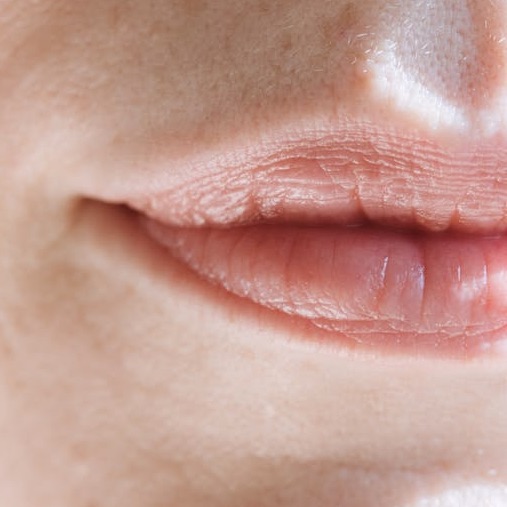
In older, aging patients, symptoms of thinning lips include lines and wrinkles forming on the lips, a gradual loss of volume, a diminishing vermilion border, and lips that are fading in lip color. Many patients also report a change in lip texture, where the skin may begin to feel rough, dry, and damaged.
In cases where thinning lips is a medical issue, symptoms can arise at any age. Some conditions that cause thinning lips are certain congenital disorders, atopic dermatitis (also known as eczema, or lip dermatitis), and psoriasis—which in rare cases has been found to erupt solely on the lips. Symptoms of a medical condition causing thin lips include scaling and cracking, itching, burning, pain, and inflammation on the lip area.
Another cause is a pre-cancerous condition called actinic cheilitis, also known as solar cheilitis, actinic keratosis of the lip, sailor’s lip, or farmer’s lip. Actinic cheilitis usually affects the lower lip epithelium itself (the outermost external layer of tissue on the bottom lip), although in as many as 10% of cases it affects the top lip as well. The condition is not necessarily dangerous. However, it can sometimes be an antecedent symptom of lip cancers like intraepidermal carcinoma, or invasive squamous cell carcinoma. Symptoms of actinic cheilitis include a loss of demarcation of the vermilion border, lesions, scaly papules, plaques, pale or yellow skin discolorations of the skin adjacent to the lip areas, ulcerations, crusting, and difficulty applying lip liners, lip gloss, and lipstick (the makeup will tend to bleed into prominent lip lines and folds surrounding the lip area).
Reasons and Causes
As we get older, the muscles around the mouth become thinner, and the proteins responsible for the elasticity in the skin like collagen and elastin begin to slow down production. The effects of the change in collagen and elastin production begin to show in our thirties and forties when our skin starts to noticeably sag, droop, and develop creases and lines.
In the lip zones, these effects can be more pronounced or can happen earlier in people with a genetic predisposition for thinning lips, or from sun exposure. Additionally, people who spend or have spent excessive time in the sun or in a tanning booth without wearing sunscreen with proper UVA/UVB protection are more likely to experience thinning lips due to solar damage of the skin.
Smoking also promotes early aging of the lips. Also known as “smoker’s lips,” people that smoke can experience early thinning of the lips due to the repeated pursing movement that the mouth makes when smoking, which causes wrinkles to form and deepen—especially in the center of the upper lip area. The toxins of the cigarette smoke are also responsible for breaking down collagen in the skin.
Other factors that can cause early thinning of the lips include hormonal changes (mostly in women) and dehydration. Keeping the lips and skin hydrated by drinking plenty of water is effective in lessening the effects of aging on the skin, as well as keeping the lips moisturized with skin care creams and lip balm products. In cases where small lips are caused by a medical condition, the reasons for the condition are usually genetic traits passed on through bloodlines, an abnormality or defect in the normal function of the immune system or skin barrier, sensitive skin due to allergies, daily habits, or other environmental factors, stress, sun exposure, and others.
Treating Thin Lips: From Fillers to Facial Plastic Surgery
Treatment of thin lips will depend on an evaluation by a certified medical professional or board-certified plastic surgeon. There are many types of lip treatments that can result in fuller lips, from temporary fillers to permanent fillers and lip implant procedures. Here are the most common options for lip enhancement treatment in the United States:
Temporary Lip Fillers: Fuller lips can be achieved without a permanent commitment, especially for those considering but not yet decided on having permanent lip implant surgery. Fillers can consist of substances like Juvederm®, CosmoDerm®, or Zyplast® and typically last around six months. These procedures are quick and minimally-invasive and can be customized according to the level of fullness desired by the patient.
Semi-Permanent Lip Fillers: Semi-permanent lip fillers are also injectable lip fillers that last longer than temporary lip fillers—usually over a year. Semi-permanent lip fillers like Sculptra®, Bellafill®, Aquamid®, and Radiesse® are also designed to stimulate natural collagen production.
Permanent Lip Fillers: While temporary and semi-permanent fillers contain materials that eventually degrade and wear out, permanent fillers contain polymethylmethacrylate microspheres, silicone, or hydrogel polymers that remain in the skin tissue indefinitely. Since these types of fillers do not dissolve in the body, they can be quite problematic if the patient decides to remove them at some point in time. In fact, some states and countries have bans on permanent fillers for the complications they can present.
Lip Implant: Lip implant surgeries are permanent procedures used by cosmetic plastic surgeons to redefine and enhance the volume of the lips. In implant surgeries, a surgeon will insert a specialized mold underneath the lip tissue using one of several types of implant materials, including Gore-Tex®, EPTFE, or expanded polytetrafluoroethylene.
Lip Augmentation with Autologen: Autologous collagen lip injections are fillers that contain human collagen derived directly from the patient’s skin. This procedure involves the harvesting and storing of the patient’s collagen cells which can be used for up to five years in future injections. Since autologen is a biological matter belonging to the body, it cannot be rejected—which means it is generally considered to be the safest and arguably the most natural-looking filler substance available in lip augmentations.
Lip Augmentation with Fat Transfer: In a fat transfer, the patient undergoes a two-part procedure to enhance the lips. In the first part, the cosmetic surgeon will harvest fat tissue from the patient’s stomach, thighs, or buttocks. In the second part, the fat will then be injected into the lips or other parts of the face to rejuvenate and fill the desired areas with soft tissue.
Lip Augmentation with SMAS Implant: Lip augmentations with SMAS implants are performed alongside sub-SMAS facelifts—a facelift technique developed in the 1980s. The sub-SMAS facelift technique is designed to preserve the structure of the SMAS (superficial musculoaponeurotic system) which is the deepest layer of tissue within the skin and subcutaneous tissue that separates the facial skin from the facial muscles. In a lip augmentation with SMAS implants, the natural fat, collagen, and fibrous tissue of the superficial musculoaponeurotic system are removed, shaped, and positioned in the lips to add volume. The benefits of this type of lip augmentation procedure include very little downtime and long-lasting results.
Lip Lift: In a lip lift surgery, the cosmetic surgeon changes the shape of the upper and lower lips by altering their position in a minimally-invasive procedure. Results include a more defined lip vermilion border and a more aesthetically pleasing lip shape.
Cosmetic Lip Tattoos: Over time, lips tend to fade in color and sometimes can lose definition, especially on the vermilion border. Cosmetic lip tattoo procedures are meant to permanently enhance the red color of the lips while increasing the border, making them look fuller, larger, and better defined.
Makeup: Makeup products and lipsticks like lip liners, lip gloss, and lip plumpers can work to create the illusion of larger, fuller lips. Some makeup artist-approved makeup tips and techniques include the use of lip liner to augment or extend the natural lip line and using darker shades of lip color to fill in the lips and make them seem more prominent. While lip cosmetics and strategic makeup techniques are not permanent, they can be a great way to augment small lips without undergoing a permanent, semi-permanent, or temporary lip augmentation procedure.