What is the anatomy of the area around the eye?
From a cosmetic perspective, the eye area extends from the brow ridge to the upper cheek bone. The frontal bone is the part of the skull that creates the forehead and contains the superciliary arch, which forms the arc at the top of the eye socket. This arch is typically more prominent in males than females.
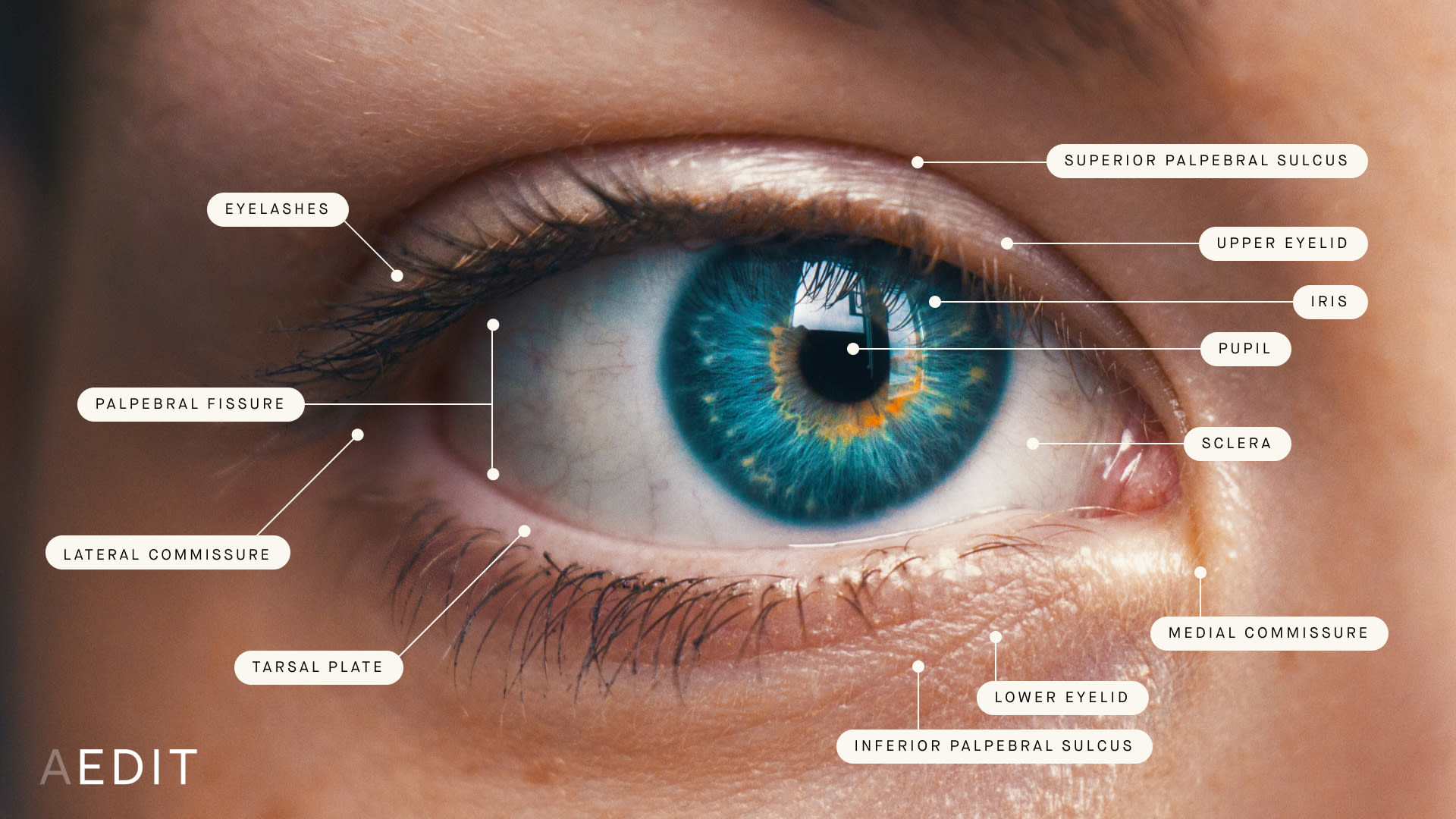
The Anatomy of the Eye
The lower portion of the eye socket is formed by both the zygomatic bones and the maxilla (upper jaw bone). Two small lacrimal bones sit at the midline portions of the eye near the nose completing the circular eye socket.
The eyebrows and eyelids serve to trap and collect debris preventing it from entering the eyes. The upper eyelid and lower eyelid meet at the medial (near the nose) and lateral (near the ear) canthi. The eyelids are lined with palpebral conjunctiva-a thin clear membrane. The medial canthus contains the lacrimal caruncle-the reddish mound on the inner eye containing sweat and oil glands. The palpebral fissure refers to the space created by the eyelids when open at rest.
The lacrimal gland is situated on the upper outer portion of the eye (under the skin) and secretes tears which then naturally run down and towards the nose where the lacrimal duct (collecting system) lies.
The eye itself is composed of the sclera (the white of the eye), the cornea (the clear protruding part), and the iris (colored part of the eye), whose size is adjusted by a sphincter muscle. Because of the sphincter muscle, the eye dilates and constricts in a circular motion.
What causes the eye area to look aged or tired?
Anyone who uses a facial moisturizer knows the skin around the eye is thin, lacks fat tissue, and has minimal musculature. These factors make this area especially susceptible to breakdown due to the lack of protection and structural support.
The eye socket is like a cavern containing the eyeball suspended by muscles, ligaments, and the optic nerve. As previously mentioned, facial bones, skin, and musculature around the eye are naturally very thin. This contributes not only to skin aging, but also the incidence of facial bone damage in traumatic accidents.
Additionally, the face — especially the brow and eyes — are constantly in motion and subject to considerable stress. Squinting in sunlight, furrowing the brow in concentration, and rubbing your face when stressed all exacerbate and accelerate skin breakdown, and the appearance of tired and aging eyes.
What are the main concerns related to aging and tired eyes?
With a basic understanding of eye anatomy, it is clear why aging and tired appearing eyes are a common concern for both men and women. Generally, eye related concerns can be broken down into three sub categories:
Under Eye Bags: The appearance of dark and puffy under eyes is caused by collagen and elastin loss leading to decreased skin structure and sagging. Additionally, thinning of skin with aging causes blood vessels to appear more prominent causing a dark appearance.
Crow’s Feet: Refers to the appearance of fine lines on the lateral aspects of the eyes. This is caused by a combination of collagen loss and daily use.
Heavy Brow: A heavy brow can be caused by a genetic predisposition to a prominent superciliary arch area or result from aging causing loss of skin and muscle tone. A heavy brow can inappropriately give the appearance of a negative or tired resting expression.
Who may wish to change their aging or tired eyes?
Aging or tired eyes are not exclusive to older men and women. Any individual with a genetically heavy appearing brow may benefit from a cosmetic procedure. Individuals with increased exposures, including stress, UV light, and other skin damage may benefit from a cosmetic eye procedure at younger ages. Older individuals who have noticed the effects of collagen loss, and accumulated wear and tear will see significant benefits from an eye procedure.
How can someone change the effects of aging and tired eyes?
Numerous invasive and non-invasive procedures exist to correct aging and tired looking eyes. Certain procedures can more effectively address a specific concern as detailed below. View all surgical and non-surgical treatment options in our guide to Eye Rejuvenation Solutions.
For Under Eye Bags:
Referring to the puffy, dark appearance that develops as we age this can be addressed by both surgical and non surgical procedures. A blepharoplasty procedure alters the appearance of the upper or lower eyelid. Lower Eyelid Blepharoplasty Transconjunctival Approach and Lower Eyelid Blepharoplasty Transcutaneous Approach are two surgical techniques designed to restore the under eye appearance. Under Eye Filler and Carboxy Therapy utilize temporary injections to enhance eye appearance and/or promote circulation.
For Crow’s Feet:
The fine lines on the lateral portions of the eye can be addressed with BoNT-A Injections. Periorbital Botox utilizes Botulinum toxin type A, a paralytic agent that temporarily freezes the muscles smoothing skin and fine lines.
For Heavy Brow:
An overly prominent appearance of the upper portion of the eye/lower portion of the forehead. A non surgical approach uses BoNT-A Injections into the forehead musculature, and is known as a Chemical Brow Lift. Surgical Brow Lift procedures provide more permanent and wide ranging results. There are numerous approaches including, Coronal Brow Lift, Endoscopic Brow Lift, Pretrichial Brow Lift, Combination Mid-brow Incision with Endoscopic Brow Lift, Traditional MidForehead Brow Lift , and Direct Brow Lift.